





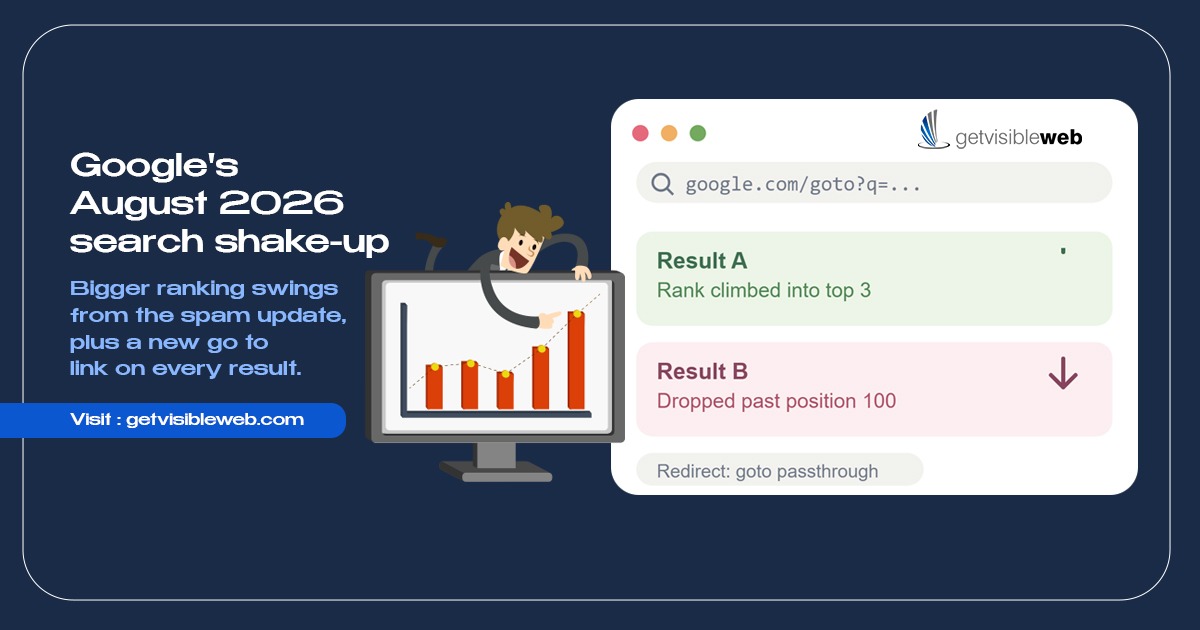
The Google August 2026 update brought two notable changes that every website owner and marketer should understand: a spam update that produced unusually large ranking swings, and a quiet rollout of a new tracking-link system inside the search results themselves. If your rankings looked a little shaky over the past couple of weeks, you weren’t imagining it. Neither change is cause for panic, but both are worth understanding if you care about your organic traffic.
Google’s August 2026 Spam Update Hit Harder Than Usual
Google regularly rolls out spam updates aimed at cleaning low-quality, manipulative, or AI-spun content out of its results. What made the August 2026 update stand out wasn’t that it happened — it’s how much movement it caused.
According to third-party ranking tracker SE Ranking, which analyzed 100,000 keywords across 20 industries in the U.S., roughly 16.7% of URLs that had been sitting in the top 10 fell completely out of the top 100 for the same keyword once the update rolled through. That’s compared to about 9.2% during a similar stretch in July when there was no confirmed algorithm change — meaning a page in the top 10 was nearly twice as likely to vanish from the first ten results pages entirely during this update.
A few other data points worth flagging for anyone managing a website’s search presence:
- Ranking volatility touched every industry SE Ranking tracked, from real estate to fashion and beauty, with top-10 volatility ranging from the mid-70s up into the mid-80s (percentage-wise) depending on the niche.
- More pages that previously couldn’t crack the top 20 broke into the top 3 after the update — a sign that Google reshuffled winners and losers rather than simply demoting a handful of obvious offenders.
- Categories where accuracy and trust matter most, like healthcare and real estate, saw comparatively less turbulence than more competitive, content-saturated niches.
The exact reasons individual pages dropped or rose aren’t public — the data shows the scale of the disruption, not which specific tactics triggered it. But the pattern is consistent with previous Google spam updates: sites relying on thin, templated, AI-generated, or otherwise low-value content tend to be the ones that lose visibility, while pages backed by genuine expertise, original research, and a track record of usefulness tend to hold steady or gain ground.
The takeaway for your site: if your traffic dipped in the days around this update, don’t jump straight to submitting a reconsideration request or rewriting everything from scratch. Start by auditing your content honestly — is it genuinely useful, accurate, and better than what’s already ranking? Google’s updates increasingly reward depth and originality over volume.
Google Quietly Rolls Out “goto” Redirect Links in Search Results
The second change is more technical, but it affects how every click from Google Search actually works. Google has begun widely deploying a new google.com/goto redirect on organic search result links, something it had been testing since July 2026. Instead of a search result linking directly to a page’s URL, the link now routes through a Google-controlled redirect first.
When a Google spokesperson was asked about the change, the company confirmed it was rolling out and described it as part of its ongoing effort to guard against evolving forms of abuse and to protect its services and users.
Industry observers tracking the rollout have noted it’s approaching a near-complete rollout across many residential IP ranges, and that the redirect links can’t easily be decoded by outside tools — meaning any service trying to read search result URLs now has to actually follow each redirect rather than parsing the link directly.
The likely motivation isn’t a mystery: Google has an active lawsuit against SerpApi over unauthorized scraping of its search results, and this kind of change makes large-scale scraping — whether by rank-tracking tools, SEO software, or AI companies pulling search data — considerably more difficult and expensive to pull off at scale.
What this means in practice:
- For most website owners, very little changes day to day. Users still land on your page after clicking a result; the redirect happens behind the scenes.
- For SEO tool users, keep an eye on your rank tracker, analytics, and referral data over the next few months. As scraping gets harder, some third-party tools may see gaps, delays, or need to update how they pull ranking data — so don’t be alarmed by odd blips in reporting dashboards that rely on scraped SERP data.
- For referral traffic reporting, it’s worth double-checking that your analytics platform is still correctly attributing traffic as “Google / organic” and not misclassifying the new redirect domain as a separate referral source.
Why These Two Stories Matter Together
On the surface, a ranking volatility report and a URL redirect change seem unrelated. But both point to the same broader trend: Google is tightening control over its search ecosystem — cracking down harder on low-quality content that gamed its way into rankings, while also making it harder for outside parties to freely extract and repackage its search data. For businesses that depend on organic traffic, the message is consistent: build a site that earns its rankings honestly, keep monitoring your visibility closely, and don’t rely too heavily on any single reporting tool that pulls data from Google’s results pages.
Keep Your Rankings Steady Through Google’s Changes
Algorithm volatility like this is exactly why an ongoing SEO strategy — not a one-time fix — matters. At GetVisibleWeb, we monitor changes like the Google August 2026 update for our clients, audit content and technical health proactively, and adjust strategy before small dips turn into lasting traffic losses. If your rankings shifted recently and you’re not sure why, get in touch with our team for a free look at what’s happening on your site.




One Comment