

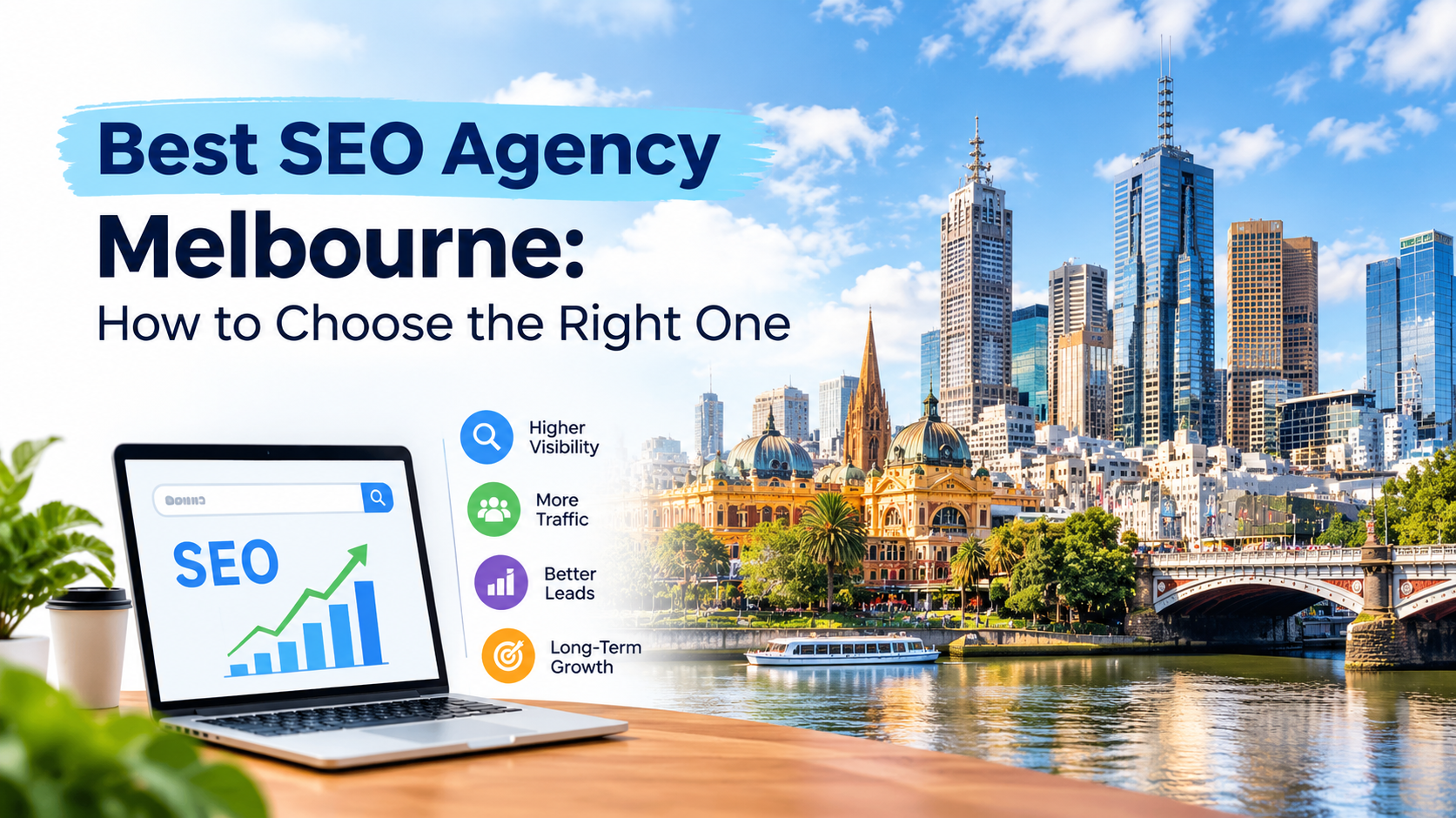
Melbourne’s search results are a battlefield, and only a specialist SEO agency knows how to win there. With local search driving most consumer decisions, generic strategies simply fall short. This guide reveals what separates top agencies from the rest: proven results, transparent reporting, local expertise, and the right questions to ask before you hire.
Melbourne’s digital market is projected to reach $5.2 billion in 2024, with over 85% of consumers researching online before purchasing. That scale of opportunity rewards businesses that treat search as a serious growth channel.
A specialist SEO agency Melbourne understands local nuances: how suburbs behave differently, which directories carry weight, and how buyers in Victoria, Australia phrase their queries. Generalist providers often miss these distinctions.
The sections below examine the competitive landscape and explain how local SEO differs from national campaigns, with a focus on Melbourne CBD and surrounding suburbs.
Melbourne’s Competitive Digital Landscape
In Melbourne, 78% of local businesses invest in digital marketing, yet only 23% rank on the first page of Google for their primary keywords. That gap reveals how many organisations spend on digital marketing without a coherent search engine optimisation strategy.
Terms such as “SEO agency Melbourne” attract roughly 1,200 monthly searches, and around 45 agencies compete for visibility in results. Winning those clicks demands more than a polished website. It requires keyword research, technical foundations, and content that matches genuine search intent. A competitor analysis and gap analysis and gap analysis help identify opportunities others miss.
Consider a Melbourne café that invested in structured on-page SEO, review management, and a well-optimised Google Business Profile. Within six months, its organic traffic rose by 150%, with most new visitors arriving via mobile searches. With roughly 65% of local searches happening on phones, mobile optimisation and page speed directly shape Google algorithm ranking.
Local trends reinforce this. Suburb-level queries, “near me” phrasing, and review-driven discovery all influence the local pack and map pack. An agency fluent in local citations, NAP consistency, and schema markup can convert that behaviour into measurable leads.
Local Search vs National SEO: Key Differences
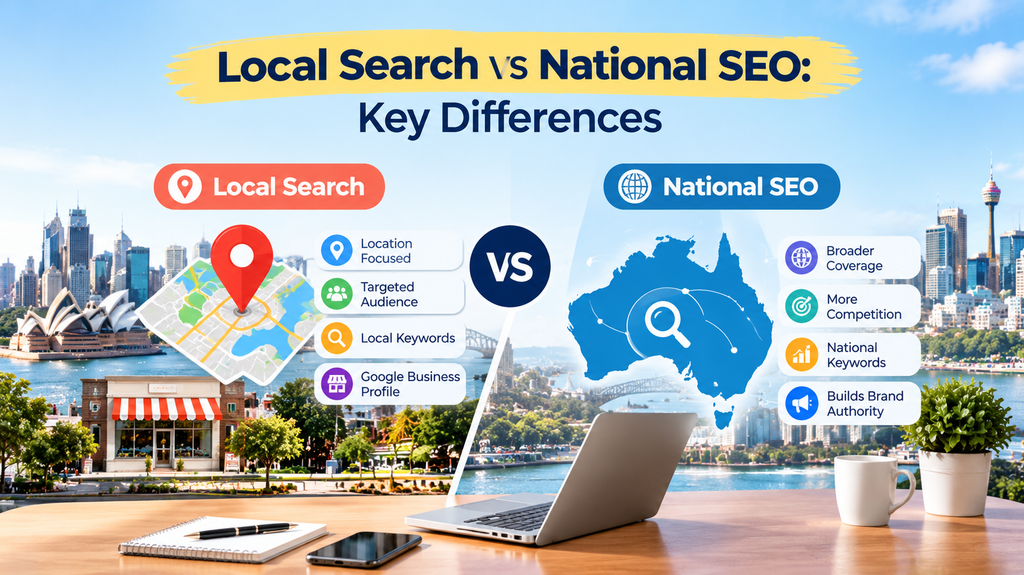
Local SEO focuses on “near me” searches, which grew by 200% in Melbourne over the past two years, while national SEO targets broader terms like “best SEO agency Australia“. Each discipline demands different tactics, budgets, and success metrics.
For a local plumber, ranking in five suburbs may generate more revenue than any national campaign. The work centres on Google Business Profile optimisation, geo-targeting, suburb targeting, and reputation management. Reviews and proximity signals often matter more than domain authority.
A national ecommerce SEO store faces a different contest. It needs link building, guest posting, and content strategy to strengthen page authority across competitive categories. Broad short-tail keywords and large-scale outreach typically drive results.
Many Melbourne businesses adopt a hybrid model. They capture suburb-level demand through geo-targeting while building national reach with pillar pages and topic clusters. This blend supports both immediate lead generation and long-term brand visibility. For small business SEO, starting with long-tail keywords often yields quick wins.
| Factor | Local SEO | National SEO |
| Primary focus | Google Business Profile, citations, reviews, suburb targeting | Domain authority, broad keywords, large-scale link building |
| Example | Local plumber ranking in 5 suburbs | National e-commerce store |
| Key tactics | NAP consistency, local pack, geo-targeting | Guest posting, outreach, content strategy |
| Best for | Service businesses, clinics, trades | Retailers, SaaS, multi-state brands |
What Separates the Best SEO Agencies in Melbourne
The top 10% of Melbourne SEO agencies achieve an average 40% year-over-year organic traffic growth for clients, compared to the industry average of 15%. That gap rarely comes down to luck. It reflects disciplined process, genuine local knowledge, and an unwillingness to cut corners on white-hat SEO.
Melbourne’s market is crowded. Hundreds of digital agencies, freelancers, and consultants compete for attention, yet only a handful consistently deliver measurable gains in organic traffic and revenue. The difference lies in how they operate day to day, from rank tracking to position monitoring.
The strongest firms blend local expertise with radical transparency and in-house talent. They understand the nuances of suburb targeting from Fitzroy to Frankston, and they treat clients as partners rather than accounts. They also stay current with semantic search and voice search trends.
When evaluating candidates, look for documented results, clear reporting habits, and a team structure you can actually verify. The three factors below separate genuine specialists from pretenders.
Proven Local Case Studies and Results
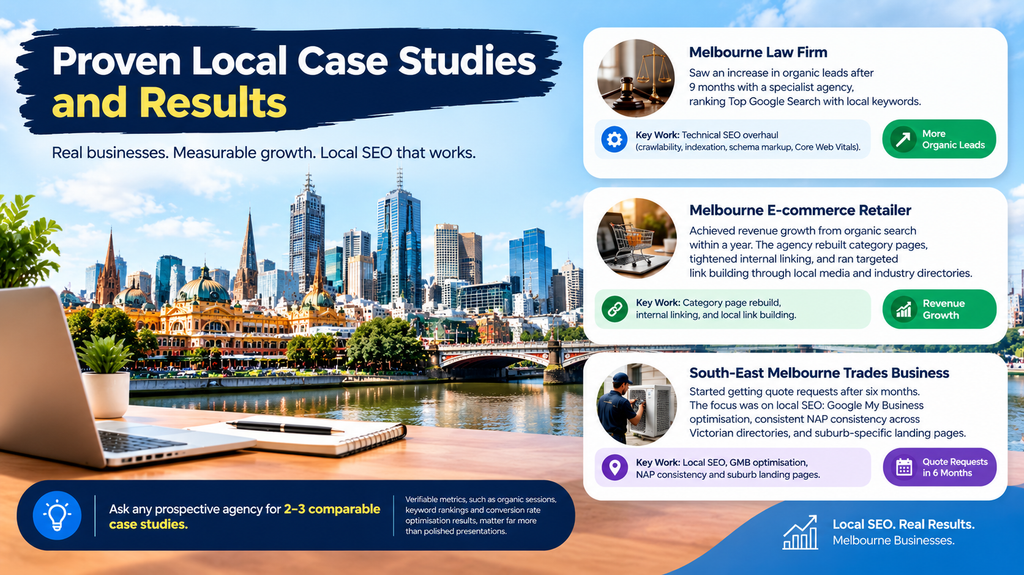
For example, a Melbourne-based law firm saw a increase in organic leads after 9 months with a specialist agency, ranking Top Google Search with local keywords. That outcome followed a full technical SEO overhaul, including fixes to crawlability, indexation, schema markup, and Core Web Vitals.
An e-commerce retailer working with a well-regarded Melbourne firm achieved revenue growth from organic search within a year. The agency rebuilt category pages, tightened internal linking, and ran targeted link building through local media and industry directories to improve the backlink profile.
A trades business in the south-east suburbs show getting quote requests after six months. The work centred on local SEO: Google My Business optimisation, consistent NAP consistency across Victorian directories, and suburb-specific landing pages.
Ask any prospective agency for two or three comparable case studies. Verifiable metrics, such as organic sessions, keyword rankings, and conversion rate optimisation results, matter far more than polished presentations.
Transparent Reporting and Communication
A survey of 200 Melbourne businesses found that 68% value monthly reporting with clear KPIs like organic sessions, keyword rankings, and conversion rates. Reporting cadence and clarity are among the strongest signals of an agency’s integrity.
Transparent reporting typically includes a monthly dashboard built in Looker Studio, drawing from Google Analytics and Google Search Console. Keyword tracking via Ahrefs, SEMrush, or Moz should show movement on agreed terms, not cherry-picked wins.
Expect a scheduled call each month to walk through results and adjust strategy. The best agencies explain dips honestly and outline corrective steps rather than hiding behind vanity metrics like impressions with no conversions. They also monitor organic CTR, branded search, and non-branded search trends.
Treat withheld data as a red flag. If an agency refuses to grant you ownership of analytics accounts or obscures the link between activity and outcomes, walk away. You should always retain full access to your own data.
In-House Expertise vs Outsourced Work
Agencies with in-house teams deliver 30% faster turnaround on technical fixes compared to those outsourcing to freelancers, according to a 2023 industry report. Speed matters in SEO, where indexing delays and lost rankings compound quickly.
In-house content writers, developers, and SEO specialists provide tighter quality control and consistency. The trade-off is cost. Retaining senior talent in Melbourne demands higher fees, which flows through to your monthly retainer. For enterprise SEO, this investment often pays off through faster execution.
Outsourcing to freelance marketplaces can reduce overheads, but quality varies wildly. A poorly briefed contractor may produce thin content or spammy backlinks that damage domain authority and invite penalty recovery challenges.
During the pitch, ask directly who will handle your account. Request names, roles, and examples of their work. A credible agency answers without hesitation; a less scrupulous one deflects.
Core SEO Services Melbourne Agencies Should Offer
A comprehensive SEO campaign in Melbourne typically includes technical audits, local optimisation, and content marketing, with 75% of agencies offering these as standard. These three pillars form the foundation of any credible SEO agency Melbourne engagement.
Technical SEO ensures your site is crawlable and fast. Local SEO connects you with nearby customers actively searching. Content and link building establish domain authority and sustained organic traffic growth.
Together, they address the full spectrum of search engine optimisation and digital marketing, from SERP ranking visibility to conversion rate optimisation. A digital agency that neglects any one of these areas leaves measurable ranking potential on the table.
Technical SEO and Site Audits
A technical audit using Screaming Frog and Google Search Console can uncover issues like broken links, slow page speed (e.g., LCP over 2.5s), and mobile optimisation errors that impact rankings. For Melbourne businesses competing in crowded SERPs, these fixes often deliver the fastest gains.
A thorough SEO audit generally takes between five and ten hours, depending on site size and complexity. The process follows a logical sequence:
- Crawl the site with Screaming Frog to map every URL, redirect chain, and SEO audit .
- Check Core Web Vitals via PageSpeed Insights, focusing on LCP, INP, and CLS.
- Fix indexing issues by reviewing robots.txt directives and canonical tags to eliminate duplicate content.
- Optimise site speed through image optimisation, browser caching, hosting performance improvements, and using a CDN.
A common mistake is ignoring mobile-first indexing, which Google uses as the primary basis for ranking. Failing to address mobile usability errors can suppress an otherwise well-optimised site. Equally, overlooking HTTPS, SSL certificate, schema markup, and clean URL structure undermines crawlability and indexing. An XML sitemap should be submitted to Google Search Console to accelerate discovery.
Local SEO and Google Business Profile Optimisation
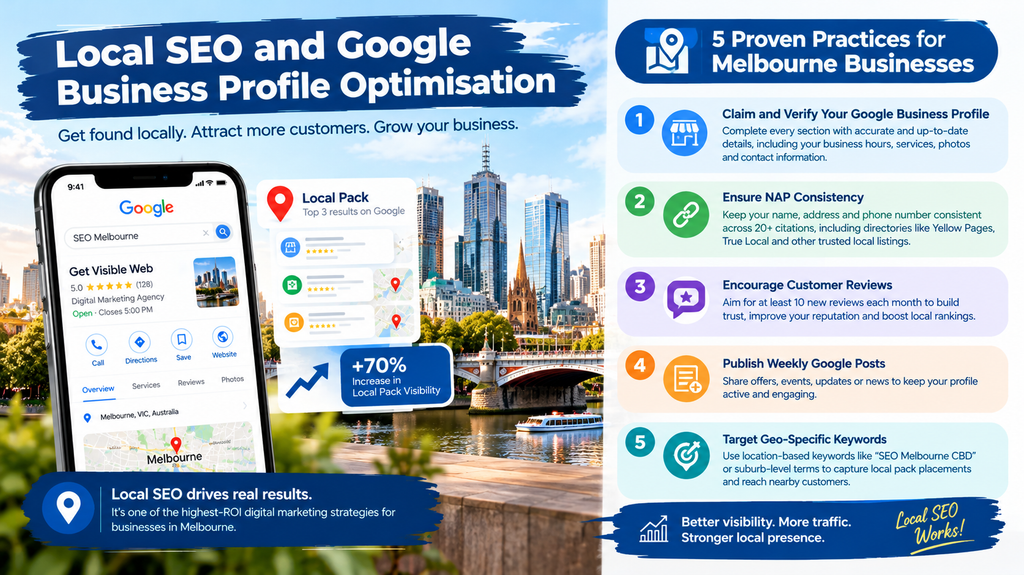
Optimising Google Business Profile can increase local pack visibility by 70%, with 80% of Melbourne consumers using GMB to find local services. For any SEO agency Melbourne serves, local SEO is often the highest-ROI discipline.
Five Practices Consistently Drive results for Victorian Businesses:
- Claim and verify the Google Business Profile, completing every field with accurate detail.
- Ensure NAP consistency across 20 or more citations, including directories such as Yellow Pages and True Local, to strengthen local SEO.
- Encourage customer reviews, aiming for at least 10 new ones monthly to strengthen reputation management.
- Publish weekly Google Posts covering offers, events, or updates to maintain profile activity.
- Target geo-specific keywords such as “SEO Melbourne CBD” or suburb-level terms to capture local pack placements.
Consider a Melbourne restaurant that invested in profile optimisation and review generation, which led to a 120% increase in calls. This illustrates how geo-targeting and consistent citations translate directly into leads for small business SEO in Victoria and across Australia.
Content Strategy and Link Building
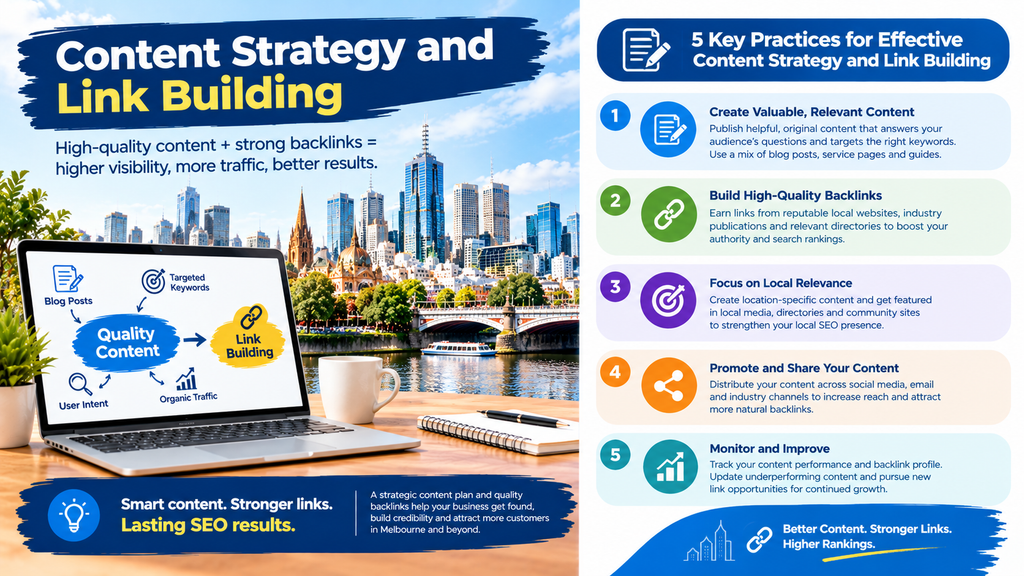
A successful content strategy for Melbourne businesses involves creating 2-4 blog posts monthly targeting long-tail keywords and LSI keywords (e.g., “best SEO agency in Melbourne CBD”) and building 5-10 quality backlinks per month. This cadence sustains organic traffic and steadily lifts domain authority.
The process begins with keyword research using Ahrefs or SEMrush to identify search intent, buyer persona needs, and gaps competitors have missed. From there, agencies build pillar content supported by topic clusters, creating a silo structure that search engines can interpret with clarity, aided by NLP and BERT understanding.
Link acquisition follows a deliberate path, focusing on pillar content and featured snippets opportunities:
1. Guest posting on reputable Melbourne business blogs and industry publications.
2. Outreach campaigns using tools like BuzzStream and Hunter.io to identify and contact prospects.
3. Personalised email templates that reference the target site and propose genuine value.
Monitoring domain authority and page authority growth using tools like Moz and Yoast confirms whether the strategy is working. White-hat techniques protect long-term rankings, whereas black-hat shortcuts risk penalties, including those from spam updates and the Helpful Content Update. Pairing content with on-page SEO, strong meta tags, title tags, and internal linking ensures every asset performs to its potential.
How to Evaluate and Choose the Right Agency
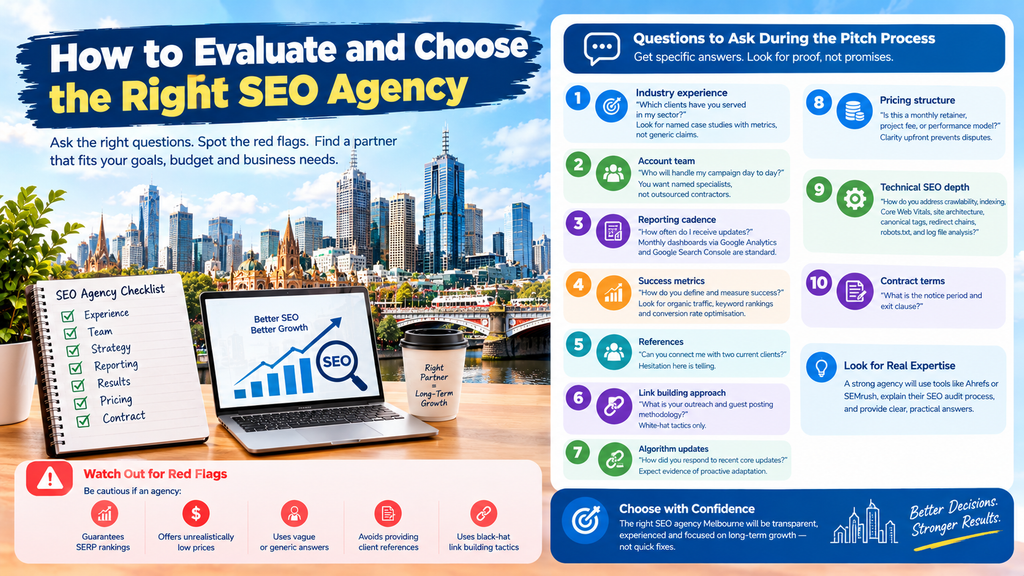
With over number of SEO agencies in Melbourne, selecting the right partner requires asking specific questions and recognising red flags like guaranteed SERP ranking. Diligence at this stage protects both budget and brand reputation.
The following criteria cover pitch interrogation, warning signs, and pricing structures, giving you a practical framework for comparison. Each element deserves scrutiny before any contract is signed.
Questions to Ask During the Pitch Process
Ask for specific examples: ‘Can you show a Melbourne client where you improved organic CTR by at least 50% in 6 months?’ and ‘What tools do you use for keyword tracking?’ Vague answers signal inexperience.
A capable SEO agency Melbourne welcomes detailed questioning. The following prompts expose genuine capability versus polished sales talk.
4. Industry experience: “Which clients have you served in my sector?” Expect named case studies with metrics, not generic claims.
5. Account team: “Who will handle my campaign day to day?” You want named specialists, not outsourced contractors.
6. Reporting cadence: “How often do I receive performance updates?” Monthly dashboards via Google Analytics and Google Search Console are standard.
7. Success metrics: “How do you define and measure success?” Look for organic traffic, keyword rankings, and conversion rate optimisation, not vanity figures.
8. References: “Can you connect me with two current clients?” Hesitation here is telling.
9. Link building approach: “What is your outreach and guest posting methodology?” White-hat tactics only.
10. Algorithm updates: “How did you respond to recent core updates?” Expect evidence of proactive adaptation.
11. Pricing structure: “Is this a monthly retainer, project fee, or performance model?” Clarity upfront prevents disputes.
12. Technical SEO depth: “How do you address crawlability, indexing, Core Web Vitals, site architecture, canonical tags, redirect chains, robots.txt, and log file analysis?“
13. Contract terms: “What is the notice period and exit clause?”
Strong candidates answer each question with specifics, referencing tools like Ahrefs or SEMrush and describing their SEO audit process. Weak ones deflect or promise the impossible.
Red Flags and Warning Signs to Avoid
Be wary of agencies that guarantee #1 rankings, use black-hat tactics like PBNs, or lack a physical Melbourne address. Such shortcuts often end in penalties that take years to recover from, especially with zero-click searches reducing visibility.
Guaranteed rankings are the clearest disqualifier. No agency controls Google algorithm, so anyone promising fixed positions is either misleading you or planning black-hat SEO that risks a manual penalty, potentially requiring a disavow file to recover.
Other warning signs include:
- No case studies or references: A legitimate firm showcases measurable outcomes from past SEO campaigns. Absence of proof suggests absence of results.
- Black-hat techniques: Link farms, cloaking, and private blog networks may deliver short-term gains, but Google penalties can erase your visibility entirely.
- Lock-in contracts without exit clauses: Twelve-month commitments with no termination option trap you with an underperforming provider.
- Opaque reporting: If you cannot see which keywords, backlinks, and pages drive results, you cannot judge value or hold anyone accountable.
- No local footprint: A genuine Melbourne presence matters for local SEO, NAP consistency, and understanding the Victorian market.
Consequences of ignoring these signals range from wasted spend to deindexed pages. A penalty recovery can cost far more than the original engagement.
SEO Pricing Models in Melbourne: Retainers, Projects and Performance-Based SEO
Choosing between SEO agencies in Melbourne involves more than comparing prices. Businesses need to understand what each pricing model includes, how it supports their growth objectives, and whether the proposed services can improve search visibility, attract qualified visitors and generate enquiries.
SEO pricing in Melbourne varies according to website size, industry competition, technical requirements and campaign scope. As an indicative 2026 benchmark, many small and medium-sized businesses invest around AUD $1,500–$3,500 per month in ongoing SEO, while more competitive campaigns can require significantly larger budgets. Project-based fees depend on the complexity and deliverables involved. These figures are estimates rather than fixed industry rates.
Comparing SEO Pricing Models
| SEO Pricing Model | Indicative Cost (AUD) | Best For | Main Advantages | Potential Limitations |
|---|---|---|---|---|
| Monthly SEO retainer | $1,500–$5,000+ per month | Ongoing SEO, content marketing, local SEO and link building | Consistent optimisation, strategic planning and ongoing improvements | Requires a continuing budget and clear performance reporting |
| Project-based SEO | Quoted according to scope; complex projects can cost $5,000–$20,000+ | Technical audits, website migrations and major SEO improvements | Defined deliverables, clear timelines and a specific scope | Does not automatically include ongoing optimisation |
| Performance-based SEO | Varies according to the agreed contract | Carefully defined outcome-based campaigns | Links payment to specified performance measures | Attribution, measurement and contract terms can be complicated |
Industry Specialisations Across Melbourne
Melbourne’s diverse economy means SEO strategies differ significantly for e-commerce, trades, health, and professional services. A SEO agency Melbourne businesses trust must tailor keyword research, content, and link building to each sector’s buying journey.
Generic campaigns rarely deliver. A retailer chasing product searches needs different tactics from a clinic bound by YMYL standards and E-E-A-T guidelines. Sector fluency shapes organic traffic and conversions.
SEO for E-commerce and Retail
For Melbourne ecommerce SEO, optimising product pages with structured data and targeting long-tail keywords like ‘buy organic skincare Melbourne’ can sharpen relevance and lift organic revenue. Product pages deserve unique descriptions, customer reviews, and rich results so search engines understand price, availability, and ratings. Platforms like Shopify SEO, WordPress SEO, and Wix SEO each require tailored approaches.
Category pages carry equal weight. Strong internal linking, descriptive title tags, and clean URL structure help these hub pages rank for broader commercial terms. Many agencies use platforms such as WordPress SEO plugins, WooCommerce, or Shopify SEO apps to manage metadata at scale. For larger catalogues, ecommerce SEO strategies are essential, while Wix SEO and headless CMS setups each require tailored approaches.
Speed matters too. Core Web Vitals directly influence Google algorithm ranking and bounce rate, so image compression, proper alt text, and mobile-first indexing checks belong in every site audit. A comprehensive SEO audit also verifies HTTPS status, a valid SSL certificate, and CDN configuration for global performance.
- Unique product descriptions and review integration
- Category page optimisation with keyword-rich headers
- Product schema markup for rich results
- Speed and mobile UX improvements
Track conversion rate, organic CTR, and average order value alongside rankings. A capable SEO specialist connects visibility gains to revenue, not just impressions, whether the client is a small business SEO project or an enterprise SEO programme.
SEO for Trades, Health, and Professional Services
A Melbourne plumber can dominate local search by optimising for ’emergency plumber Melbourne’ and building citations on 30+ local directories. Trades rely on local SEO, a complete Google My Business profile, and steady review generation to win the local pack. Prioritise NAP consistency across every listing, from Melbourne CBD to regional Victoria, and ensure each citation reflects the same business details across Australia.
Health providers face stricter rules. YMYL topics demand demonstrable E-E-A-T, so content should cite qualified authors, display credentials, and feature patient testimonials handled with care. Keyword choices like ‘physiotherapy Carlton’ must reflect genuine expertise and be supported by LSI keywords that match real patient queries.
Professional services, such as law or accounting firms, benefit from thought leadership. Publishing authoritative articles and maintaining an active LinkedIn presence builds domain authority and attracts referral traffic.
· Trades: NAP consistency, suburb targeting, review management
· Health: credential signals, ethical testimonials, compliant content
· Professional services: pillar pages, guest posting, LinkedIn visibility
Each sector needs its own keyword research and content strategy. Aligning search intent with the right tactics is what separates a strong SEO campaign from a forgettable one, whether you are optimising for a single SERP ranking or building a full on-page SEO framework.
Measuring Success and ROI
Tracking the right KPIs, organic traffic, keyword rankings, and conversion rate, is essential to prove SEO ROI for Melbourne businesses. Without disciplined measurement, even a well-executed search engine optimisation campaign becomes an exercise in faith rather than strategy.
An SEO agency Melbourne clients trust will establish baselines before work begins, then report against them with transparency. That means tying every activity, from technical SEO fixes to link building, back to commercial outcomes. Technical foundations such as an XML sitemap and clean site architecture are non-negotiable.
Measurement also protects your investment. When you can see precisely which keywords, pages, and campaigns drive revenue, you can direct budget toward what works and away from what does not.
Key Metrics That Actually Matter
Focus on organic sessions, conversion rate, and keyword rankings in the top 3 positions; these correlate with revenue growth, unlike vanity metrics like impressions. A competent SEO specialist will frame every report around these five indicators, using tools such as Google Analytics, Ahrefs, SEMrush, and Moz to validate progress.
- Organic traffic: Track sessions in Google Analytics, segmented by landing page and suburb, to see which content earns qualified visitors.
- Keyword rankings: Use Ahrefs or SEMrush to monitor positions for priority terms, watching movement into the top 3 results.
- Conversion rate: Measure goal completions, such as form submissions or calls, to connect visibility with lead generation.
- Click-through rate. Google Search Console reveals how often your listings earn clicks from the SERP, exposing weak title tags or meta tags and highlighting opportunities to improve organic CTR.
- Return on investment: Compare revenue attributed to organic search against your monthly retainer to confirm the campaign pays for itself.
Benchmark each metric at the outset and review monthly. Context matters: a Melbourne CBD retailer and a B2B consultancy will define success differently, so targets should reflect your sector, competition, and search intent.
Pair these figures with qualitative signals, including bounce rate and dwell time, to understand whether visitors genuinely engage. Numbers alone rarely tell the full story of user experience, and modern NLP and BERT-driven search models reward content that satisfies intent.
Timelines: What to Expect in Months 1-12
Expect little change in months 1-3 as technical fixes and content creation take effect; significant organic growth typically appears in months 4-6, with compounding results by month 12. Patience is not a weakness here, it is a prerequisite.
Months 1 to 3 centre on the SEO audit. Your agency resolves crawlability and indexing issues, improves Core Web Vitals, refines URL structure, and completes keyword research. Rankings may dip slightly before they rise, which is normal. Historical updates such as Panda, Penguin, and Hummingbird shaped today’s quality expectations, while the Helpful Content Update now rewards genuinely useful material.
Months 4 to 6 shift toward production. Fresh content marketing assets publish, on-page SEO matures, and outreach secures initial backlinks. Early ranking gains emerge, particularly for long-tail keywords with modest competition.
Months 7 to 12 deliver the compounding phase. Domain authority strengthens, local SEO signals such as NAP consistency and Google Business Profile activity mature, and conversion rate optimisation lifts returns. Several factors influence pace: industry competitiveness, site history, budget, and whether white-hat SEO practices are applied consistently. Sites using frameworks such as Yoast for metadata and server-side rendering for JavaScript SEO for JavaScript SEO often see faster technical wins.
By month 12, a well-managed campaign should show measurable growth in organic traffic and lead generation, with reporting that ties each gain to revenue.
Final Recommendations and Next Steps
Start by auditing your current SEO performance using free tools like Google Search Console, then shortlist 3 to 5 Melbourne agencies that specialise in your industry. This disciplined approach separates genuine specialists from generalists who merely dabble in search engine optimisation. A careful shortlist saves months of misdirected effort and prevents costly mistakes.
The right partner will demonstrate proven local results, transparent reporting, and in-house expertise rather than outsourced labour. Ask how they approach keyword research, technical SEO, and local SEO for Melbourne businesses specifically. Their answers reveal whether they understand your market or simply recycle generic tactics.
Remember that white-hat SEO builds durable domain authority through legitimate link building and quality content marketing. Agencies promising rapid Google ranking gains via black-hat SEO place your organic traffic at serious risk. Prioritise longevity over shortcuts.
To move forward with confidence, follow these actionable steps:
6. Conduct a self-audit of your site’s crawlability, indexing, and Core Web Vitals using free tools.
7. Request detailed proposals from three SEO agency Melbourne candidates, comparing their SEO strategy and deliverables.
8. Ask for references from comparable clients and verify their claimed outcomes.
9. Set clear KPIs covering organic traffic, conversion rate optimisation, and ROI before signing any monthly retainer.
Scrutinise each proposal for evidence of competitor analysis, gap analysis, and a coherent content strategy built around search intent. A credible agency will explain how on-page SEO, schema markup, and internal linking combine to strengthen your online presence. Vague promises without methodology should raise immediate concern.
Insist on performance reporting tied to Google Analytics and Google Search Console, with visibility into impressions, sessions, and click-through rate. Transparent agencies welcome this scrutiny. Those who resist likely have something to conceal.
Ultimately, the finest SEO agency Melbourne offers is a partnership grounded in measurable progress and honest communication. Take your time, ask discerning questions, and select a team whose expertise aligns with your ambitions. Your organic traffic and brand visibility will reflect that diligence for years to come.