



By GetVisibleWeb — Digital Marketing Agency serving Costa Mesa, Orange County, and businesses across California.
For twenty-five years, “getting to the top of Google” meant one thing: rank in the top three blue links. That definition just broke.
Today, a growing share of the people who would have found your business through a Google search are instead asking ChatGPT, Google’s AI Overviews, Perplexity, or Gemini a question — and getting a complete answer without ever seeing a list of websites, let alone clicking one. If your business isn’t the source that AI is pulling from, you’re invisible in a conversation that used to be a search result you could win.
This is the story behind two new acronyms every business owner searching “digital marketing agency near me” needs to understand: GEO (Generative Engine Optimization) and AEO (Answer Engine Optimization). Below, we break down exactly what they are, why they matter more than ever in 2026, and the specific steps a digital marketing agency for small business should be taking right now — whether you’re a local shop in Costa Mesa or a growing company anywhere in California.
Table of Contents
- What Is Generative Engine Optimization (GEO)?
- What Is Answer Engine Optimization (AEO)?
- GEO vs AEO vs SEO: What’s the Real Difference?
- The Numbers: Why This Shift Is Already Costing (or Making) You Money
- How to Optimize for ChatGPT Search and SearchGPT
- Perplexity SEO Strategy – What Actually Gets You Cited
- Google AI Overviews: The Overlap With Traditional SEO
- Local Businesses in Costa Mesa & California: The “Near Me” + AI Opportunity
- A Practical GEO and AEO Action Plan for Small Businesses
- How GetVisibleWeb Gets Your Website to the Top of Google — and Into AI Answers
- FAQ: GEO, AEO, and Getting Found Online
1. What Is Generative Engine Optimization (GEO)?
Generative Engine Optimization (GEO) is the practice of structuring your website and content so that AI systems like ChatGPT, Google AI Overviews, Perplexity, Gemini, and Claude actually cite your business when they generate an answer for a user. The term was originally coined in a 2023 research paper from Princeton, Georgia Tech, and IIT Delhi, later presented at the 2024 KDD conference — and by 2026 it’s become a standard line item in marketing budgets rather than an experimental idea.
Here’s the core distinction: traditional SEO gets you a position in a list of links. GEO gets your business mentioned, described, and recommended inside the actual answer — sometimes with a link back to your site, sometimes without one, but always with the implicit endorsement of being the source the AI trusted.
The original academic research on GEO found something counterintuitive that still holds true today: tactics like keyword stuffing, which used to move the needle in old-school SEO, actually hurt visibility in generative engines. What works instead are things like adding original statistics, citing credible sources, and including direct quotations and data — techniques that can lift visibility in AI-generated answers by roughly 30–40%.
2. What Is Answer Engine Optimization (AEO)?
Answer Engine Optimization (AEO) is closely related but more specific: it’s the discipline of structuring individual pieces of content so they can be easily extracted, trusted, and cited as a direct answer to a single question. Think of AEO as the tactical, page-level layer, and GEO as the broader brand-visibility strategy across the entire AI ecosystem.
AEO grew out of the earlier “voice search optimization” world — but as most voice queries now route through the same AI models powering chat search, AEO has effectively absorbed and replaced that older discipline. If someone asks Siri, Alexa, or Google Assistant a question, there’s a good chance the answer is generated the same way ChatGPT or an AI Overview would generate it.
In practice, AEO means:
- Answering the exact question a searcher would ask, in the first 40–60 words of a section
- Using clear question-based headers (H2/H3) that mirror natural language queries
- Adding FAQ and HowTo schema markup so machines can parse your answers
- Backing up every claim with a specific number, source, or example
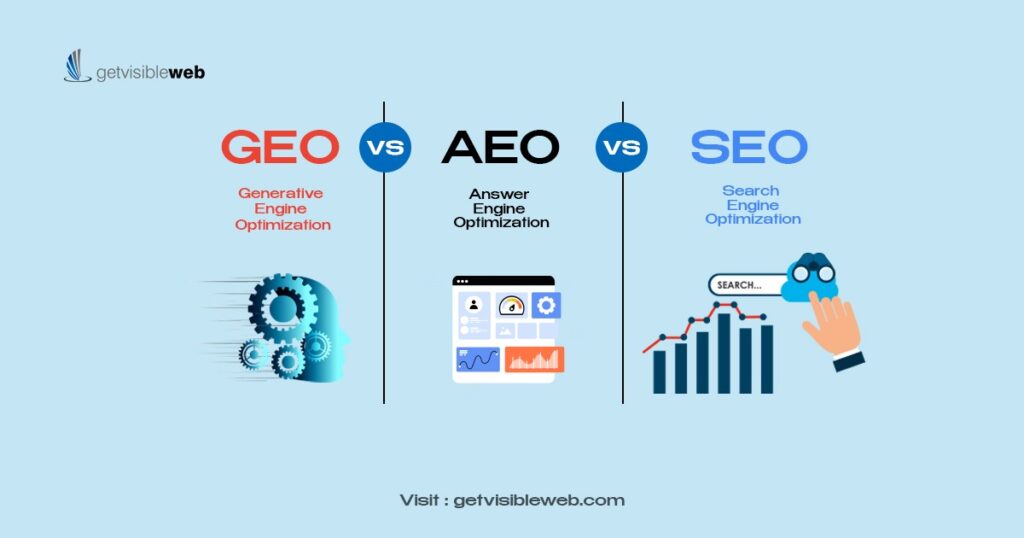
3. GEO vs AEO vs SEO: What’s the Real Difference?
| Traditional SEO | AEO | GEO | |
|---|---|---|---|
| Goal | Rank in search results | Be the direct-answer source for one question | Be cited/recommended across the whole AI ecosystem |
| Success metric | Rankings, clicks, organic traffic | Featured snippets, direct-answer inclusion | Citation frequency, brand mentions, “share of model” |
| Primary tactic | Backlinks, keywords, domain authority | Structured, question-first content + schema | Statistics, sourcing, entity authority, third-party mentions |
| Platforms | Google, Bing organic results | Featured snippets, voice assistants | ChatGPT, Perplexity, Gemini, AI Overviews, Copilot |
The three aren’t competitors — they’re layers. Strong SEO is still the foundation almost every AI system needs, since most generative engines still lean heavily on traditional search indexes to find candidate sources. AEO makes individual pages extractable and quotable. GEO builds the broader brand credibility that gets you chosen and named, not just linked.
4. The Numbers: Why This Shift Is Already Costing (or Making) You Money
The data on this shift is no longer speculative — it’s measurable, and it’s moving fast:
Traditional organic search click-through rates have dropped sharply wherever an AI Overview appears, with some analyses showing a 61% decline in organic CTR on queries where Google’s AI Overview is present.
Zero-click searches — where the user gets their answer without visiting any website — now account for well over half of all Google searches, and the share continues climbing year over year.
ChatGPT alone now reaches somewhere in the range of 700–880 million weekly users, a figure that has grown dramatically since 2024.
Research from Princeton and Georgia Tech found that applying core GEO tactics — adding statistics, citing sources, using direct quotations — can boost a page’s visibility in generative engine answers by up to 40%.
Independent benchmarking in 2026 found that AI Overview citations overlap with Google’s traditional top-10 results far less than most marketers assume — in some studies, the overlap between ChatGPT’s cited sources and Google’s top 10 is estimated at less than 10%. That means ranking #1 on Google no longer guarantees you show up in the AI answer at all.
Traffic that does arrive from AI search platforms tends to convert at a noticeably higher rate than traditional organic traffic — multiple industry studies place AI-referred conversion rates several times higher than standard organic search, since users arrive already informed and closer to a decision.
On the local side, a growing share of consumers — estimates put it around 45% — now say they use ChatGPT or similar AI tools to get local business recommendations, not just Google Maps.
The takeaway for any small business owner Googling “get my website on top of Google” in 2026: ranking #1 the old way is still valuable, but it’s no longer the whole game. If your competitor is the one ChatGPT recommends when a customer asks “what’s the best digital marketing agency near me,” you can be sitting at position one on Google and still lose the customer.
5. How to Optimize for ChatGPT Search and SearchGPT
ChatGPT’s search functionality (and the broader SearchGPT integration across OpenAI and Microsoft products) leans heavily on live web retrieval, which means traditional technical SEO still matters — but the selection criteria for what gets cited are different from classic ranking factors. Here’s what consistently improves visibility:
Submit your sitemap to Bing Webmaster Tools, not just Google Search Console. ChatGPT’s search retrieval draws significantly from Bing’s index, so Bing visibility is now a real ranking factor for AI citations, not an afterthought.
Lead every page and section with the direct answer. ChatGPT tends to summarize and synthesize the top handful of results for a query — content that states its conclusion in the opening sentences gets pulled into that synthesis far more often than content that builds up to the point.
Build genuine entity authority. ChatGPT forms “preferences” about brands based on how consistently they’re mentioned across multiple independent sources — review sites, industry publications, forums, comparison articles — not just your own website. A brand mentioned in ten different credible places is treated very differently than one that only talks about itself.
Keep content comprehensive, not thin. Studies analyzing AI citation patterns consistently find that longer, more data-rich pages earn disproportionately more citations than short pages targeting the same query.
Add original statistics and cite your sources. This is the single tactic researchers have found to correlate most strongly with increased AI visibility.
6. Perplexity SEO Strategy – What Actually Gets You Cited
Perplexity operates differently from ChatGPT in one important way: it shows its citations inline, in real time, which makes it one of the easiest platforms to actually test and measure your own visibility. A working Perplexity strategy looks like this:
Prioritize factual accuracy above all else. Perplexity places heavy weight on verifiable, fact-checkable content, and it’s quick to favor sources that other reputable sites also confirm.
Structure content with clear, extractable claims. Perplexity tends to lift specific sentences rather than paraphrasing an entire page, so each paragraph should be able to stand alone as a correct, complete statement.
Earn third-party citations. Because Perplexity shows its sources, it’s possible to directly search your target queries on the platform, see exactly which pages it’s pulling from, and reach out to build a presence on those same pages — review sites, comparison posts, and industry roundups.
Freshness matters. Perplexity’s real-time retrieval means recently updated content has a real advantage over stale pages, even ones with strong historical authority.
7. Google AI Overviews: The Overlap With Traditional SEO
Of all the generative engines, Google’s AI Overviews stay closest to classic SEO fundamentals — research consistently shows the vast majority of AI Overview citations come from pages already ranking in Google’s organic top 10. In other words: you still need strong traditional SEO to have a real shot at AI Overview visibility. That means:
- Solid technical SEO (crawlability, site speed, mobile usability)
- Strong topical authority and internal linking
- FAQ, HowTo, and Article structured data
- Content that directly and concisely answers the query in the first 100–200 words
If ranking on Google’s first page has felt like table stakes for years, in 2026 it’s become the entry ticket to AI Overview visibility too — not a separate, optional strategy.
8. Local Businesses in Costa Mesa & California: The “Near Me” + AI Opportunity
If you’re a small business owner in Costa Mesa or anywhere across California searching for a marketing agency for small business or typing “digital marketing companies near me” into Google, here’s what the local data shows:
“Near me” search volume has grown enormously over the past several years, with some tracking platforms reporting well over 200 million monthly “near me” searches in early 2026 alone.
Nearly half of all consumers now say they “always” or “often” add “near me” to their local searches.
The vast majority of consumers — north of 90% — research a local business online before ever visiting or calling, and a significant share now do that research inside an AI assistant rather than a traditional search engine.
Businesses with a complete, verified Google Business Profile are measurably more likely to be visited and considered for purchase than those with incomplete listings.
Perhaps most importantly for local businesses: research on AI-generated local recommendations has found that visibility inside tools like ChatGPT is significantly harder to earn than visibility in Google’s local map pack — meaning most local competitors haven’t figured this out yet. That’s a real window of opportunity for a business willing to move first.
For a business in Costa Mesa, that means local SEO and GEO now need to work together: a complete, accurate Google Business Profile; consistent business information across every directory; genuine, recent customer reviews; location-specific service pages; and content that positions your business as a recognized name across Orange County — not just a listing buried in a directory.
9. A Practical GEO And AEO Action Plan for Small Businesses
If you’re managing this yourself before bringing in a digital marketing agency, here’s where to start:
1. Audit where you currently stand. Ask ChatGPT, Perplexity, and Gemini the exact questions your customers would ask (“best digital marketing agency in Costa Mesa,” “how do I get my website to the top of Google,” etc.) and see who gets mentioned. If it isn’t you, that’s your baseline.
2. Fix the foundation first. Site speed, mobile usability, clean site structure, and a complete Google Business Profile — none of this is optional. GEO doesn’t replace SEO; it’s built on top of it.
3. Restructure key pages to answer questions directly. Add clear H2/H3 headers phrased as real questions, followed immediately by a concise, direct answer.
4. Add real data. Original statistics, case studies with real numbers, and cited sources consistently outperform generic, opinion-based content in AI citation studies.
5. Build your presence beyond your own website. Reviews, local directories, industry publications, and comparison sites all feed the models that decide who gets recommended.
6. Implement schema markup. FAQ, HowTo, LocalBusiness, and Article schema all help AI systems correctly parse and trust your content.
7. Update content on a regular cycle. Freshness is a measurable factor across every AI platform — content that hasn’t been touched in over a year steadily loses ground to competitors who keep theirs current.
8. Track citations, not just rankings. Add “AI citation checks” to your monthly marketing routine alongside your traditional rank tracking.
10. How GetVisibleWeb Gets Your Website to the Top of Google — and Into AI Answers
This is exactly the work we do every day for clients across Costa Mesa and California. As a digital marketing agency, GetVisibleWeb builds strategies that cover both sides of the search world businesses now live in:
- Traditional SEO to get your website to the top of Google — technical audits, on-page optimization, content strategy, and link building.
- Local SEO built specifically for California businesses competing on “near me” searches, including Google Business Profile management and location-specific content.
- GEO and AEO strategy to make sure your business is the one ChatGPT, Perplexity, and Google’s AI Overviews actually recommend — not just a link buried on page two.
- Content built for both humans and AI — clear, statistic-backed, genuinely useful content that ranks, converts, and gets cited.
Whether you’re searching for a digital marketing agency in California, a marketing agency for small business, or simply typing “get my website on top of Google” into the search bar at 11 p.m. wondering why your competitor keeps showing up instead of you — that’s the exact problem we solve.
Ready to see where you stand? Get in touch with GetVisibleWeb for a free visibility audit covering both your Google rankings and your current presence inside AI search tools.
11. FAQ: GEO, AEO, and Getting Found Online
Is SEO dead because of GEO and AEO?
No. Every major study on this shift shows AI systems still lean heavily on traditional search rankings and indexed content to decide what to cite. SEO is the foundation GEO and AEO are built on top of — not a replacement for it.
How long does it take to see results from GEO and AEO?
Most agencies and researchers report a lag of several weeks to a few months, depending on how strong your existing SEO foundation is. Businesses with established technical SEO and content tend to see AI citation improvements faster than businesses starting from scratch.
Do I need a separate strategy for ChatGPT, Perplexity, and Google AI Overviews?
Largely, no — the core principles (clear structure, direct answers, real statistics, credible sourcing, freshness) apply across all platforms. There are platform-specific nuances, like Bing indexing for ChatGPT and inline citation checking on Perplexity, but you don’t need to rebuild your entire content strategy for each one.
What’s the single highest-impact thing a small business can do first?
Make sure your Google Business Profile is complete and accurate, and start restructuring your most important pages to answer the exact questions your customers are already asking — in plain, direct language, backed by real numbers.
Does GetVisibleWeb work with businesses outside Costa Mesa?
Yes — while we’re proud to serve Costa Mesa and Orange County directly, we work with small businesses across California looking to get their website to the top of Google and stay visible as search continues shifting toward AI-driven answers.
GetVisibleWeb is a digital marketing agency helping small businesses in Costa Mesa and across California get found — on Google, and now in AI search. Visit getvisibleweb.com to get started.